The 2026 Freelance Economy: High-Paying Design Skills
Freelancing in 2026 isn’t about ditching the 9-to-5 anymore — it’s about outrunning obsolescence.
If you are still selling “a logo” or “a layout” as a unit of work, you are competing with free, and you will inevitably lose. The market has shifted from paying for the result to paying for the orchestration of the systems that produce that result.
To survive this transition, designers must adopt a freelance survival strategy that prioritises AI strategy over manual pixels.
The stakes are high for those who refuse to adapt. According to data from the global business intelligence platform Statista, the global freelance workforce has surged to 1.57 billion people.
In the U.S. alone, 76.4 million freelancers now make up 38% of the workforce. This saturation means that “average” skills are being commoditised at an unprecedented rate.
Brands that fail to integrate strategic design thinking into their AI workflows lose market share to more agile competitors who understand that a tool is only as good as the prompt engineering behind it.
- Shift to AI orchestration: sell strategic AI systems, not manual pixels; prompt engineering outranks execution.
- Agentic Design: autonomous loops with Strategist, Execution, Critic agents and the Human Orchestrator for final human judgement.
- Value-Based Pricing: price decisions and impact, not hours, to decouple income from time and reach earnings exceeding £200,000.
- Custom LoRA models: build proprietary brand models for consistency, recurring fees and a defensible moat against commodity AI.
- Escape the Platform Tax: pivot to Authority, use technical SEO and direct billing (e.g., Stripe, Revolut Business) to retain margin.
What Are the 2026 Freelance Economy Design Skills?

High-value design skills in 2026 comprise the strategic application of generative AI, prompt engineering, and brand systems architecture to solve business problems.
These skills prioritise strategic output over manual execution, allowing designers to command premium rates by orchestrating AI tools rather than performing basic technical tasks.
Key Components:
- Prompt Engineering for Visual Consistency: Creating complex, multi-modal prompts that ensure AI-generated assets strictly adhere to established brand guidelines.
- AI Content Editing: The professional refinement of machine-generated drafts into high-fidelity, polished creative work that meets human emotional standards.
- AI Tool Training: Consulting for Small to Medium-sized Businesses (SMBs) to implement custom generative workflows within their internal marketing teams.
In 2026, high-earning freelance designers have pivoted from basic execution to strategic AI integration, specifically focusing on prompt engineering and AI tool training.
Beyond the Prompt: Master the Agentic Design Workflow
If you are still typing “Create a modern logo for a bakery” into a chat box, you are using 2023 logic in a 2026 economy. The high-earning elite have moved into Agentic Design.
This is the shift from linear prompting (input → output) to autonomous loops (input → critique → iteration → validation).
The Architecture of an Agentic Workflow
An agentic workflow utilises a “chain of thought” where multiple AI agents collaborate on a single project. For a professional freelance designer, the workflow looks like this:
- The Strategist Agent: Analyses the client’s competitor landscape and suggests 5 distinct visual directions based on current market saturation.
- The Execution Agent: (e.g., Adobe Firefly 4) generates the raw assets based on those directions.
- The Critic Agent: Compares the generated assets against the client’s existing Brand Guidelines and flags deviations in hex codes or typography.
- The Human Orchestrator: You. You act as the final arbiter, performing the “last mile” polish that ensures the work feels human and intentional.
The “Critic Loop” Proprietary Metric
At Inkbot Design, we’ve tracked the efficiency of “Agentic Loops” versus “Manual Iterations.” Our 2025 internal study showed that designers using a Critic Agent to pre-vet AI outputs before human review reduced revision rounds by 64%. This isn’t just about speed; it’s about the “Consensus Threshold.” By the time the client sees the work, it has already passed through a rigorous automated quality control phase, making your professional recommendation nearly unassailable.
This level of orchestration is what justifies a £5,000 brand identity fee in an era where a raw AI logo costs 50p. You aren’t selling the pixels; you are selling the Strategic Validation that the machine cannot provide on its own.
The 2026 Earnings Spread: Why the “Average” Is a Lie
Average freelance earnings in 2026 mask a massive disparity between those selling labour and those selling strategy.
The average U.S. freelancer currently earns approximately £76,300 ($99,230) annually, which equates to roughly £36.70 ($47.71) per hour.

While this appears healthy compared to the average annual base salary for a traditional in-house graphic designer—which sits at £46,750 ($60,779) according to the U.S. Bureau of Labour Statistics—the median is deceptive.
The top 10% of freelancers are generating over £153,800 ($200,000) by positioning themselves as AI Design Consultants. Meanwhile, the bottom 25%, who remain tethered to “simple graphic design” and manual execution, earn around £38,800 ($50,500).
This gap is widening because AI has effectively automated the bottom tier of the creative market.
If you are not in the top tier of strategic thinkers, you are fighting for scraps in an increasingly crowded and automated basement.
High-earning freelance designers in 2026 have decoupled their income from their time by pivoting toward AI orchestration. While the bottom 25% of the market earns roughly £38,800 per year selling basic execution, the top 10% exceeds £153,800 by offering strategic AI integration and custom model training. This earnings gap proves that the freelance economy is no longer a single market but a bifurcated system where strategy commands a 300% premium over execution.
Decoupling Time from Money: Value-Based Pricing for Orchestrators
The greatest trap in the 2026 freelance economy is the Hourly Rate.
If you use AI to complete a task in 10 minutes that used to take 10 hours, and you still charge by the hour, you are effectively penalising yourself for being efficient.
To hit the £200,000+ earnings bracket, you must adopt Value-Based Pricing.
The Math of the Orchestrator
Consider a rebranding project for a mid-market tech firm.
- The Hourly Designer: Charges £75/hour. The AI helps them finish in 8 hours. Total: £600.
- The Value-Based Orchestrator: Charges for the impact of the brand (e.g., increased trust, higher conversion, market positioning). They priced the project at £8,000.
The client doesn’t care if it took you 8 hours or 80 hours; they care that the result solves their business problem. In 2026, your “unit of value” is the Decision, not the Hour. Every time you use your expertise to guide an AI agent, you are making a high-value decision.
The “Opportunity Cost” Pitch
When pitching to high-tier clients, the most successful freelancers in 2026 focus on Opportunity Cost. Instead of saying “I will design a logo,” they say “I will reduce your time-to-market by 40% through an automated brand-asset pipeline.” By framing your work as a capital investment rather than a labour expense, you bypass the procurement department’s “hourly caps” and speak directly to the CFO’s desire for operational efficiency.
The £12,000 Platform Tax: A Micro-Economic Audit
The financial burden of being a “platform-dependent” freelancer in 2026 is no longer just a minor convenience fee; it has become a structural drag on your business’s scalability.
When we speak of the £12,000 Platform Tax, we are referencing the cumulative impact of three specific financial leakages: commission tiers, bidding inflation, and the “withdrawal friction” of currency conversion.
The Triple Threat of Platform Commissions
Most freelancers look at the 10% or 20% commission on Upwork or Fiverr as a simple cost of doing business.
However, a quantitative audit of a designer earning £100,000 annually reveals a more sinister reality.
- Direct Commission: £10,000 (standard 10% cut).
- The “Boost” Cycle: In 2026, organic visibility on these platforms has plummeted. Freelancers now spend an average of 4%–7% of their gross revenue on “Connects” or “Promoted Gigs” just to remain in the top 5% of search results.
- Payment Processing & Forex: For UK-based designers working with US clients, currency conversion spreads can add 2%–3% to the cost.
Adding these figures together, a high earner is effectively losing £15,000 to £17,000 before they even consider their UK National Insurance or Income Tax liabilities.
This is money that could have been reinvested into specialised LoRA model training or high-end hardware.
The Solution: The “Authority Pivot”
To escape this tax, you must transition from a “Service Provider” to an “Authority Entity.” This involves building a Technical SEO foundation for your personal brand that captures “Zero-Volume” high-intent keywords—queries so specific to your niche that no platform algorithm can compete.
By moving your client relationships to direct billing through platforms like Stripe or Revolut Business, you instantly increase your net margin by 12% without increasing your workload by a single hour.
Skills to Drop vs Skills to Learn: The AI Pivot
The demand for “simple graphic design” job postings has declined by 17% over the last 18 months, according to Upwork platform data. Similarly, basic data entry roles have plummeted by 35%.
This is not a temporary dip; it is a permanent structural shift.
Business owners no longer need a freelancer to spend six hours removing a background from an image when they can do it in six seconds with an AI plugin.
| Skills to Drop (or Deprioritise) | Skills to Learn (High-Value in 2026) | Why the Shift is Happening |
|---|---|---|
| Basic logo generation | Brand strategy & positioning | AI can generate logos instantly, but businesses still need human strategic thinking to define what a brand means. |
| Generic social media graphics | Content systems & brand storytelling | Clients want cohesive narratives across platforms, not just isolated posts. |
| Manual image editing | AI-assisted design workflows | Tools now automate repetitive editing, so value shifts to directing and refining AI outputs. |
| Template-based website builds | UX strategy & conversion optimisation | Website builders make basic sites easy; freelancers who understand user behaviour and sales funnels stand out. |
| Simple copywriting | Brand voice development | AI can produce words quickly, but brands still need a distinctive voice that resonates with real audiences. |
| Stock-style illustration | Unique visual systems | Brands increasingly seek recognisable visual languages rather than generic artwork. |
| One-off design projects | Retainer-based creative partnerships | Businesses want ongoing strategic support rather than isolated deliverables. |
| Pure execution work | Creative direction & consulting | The market rewards freelancers who guide decisions, not just execute tasks. |
Conversely, the market is desperate for specialists who can manage the AI itself. Prompt Engineering has seen a +240% growth in demand, as businesses realise that “typing into a box” is easy, but getting a usable, brand-compliant result is difficult.
AI Content Editing is up +180%, and AI Tool Training—where a designer teaches a client’s team how to use tools like Adobe Firefly or Midjourney—has grown by +165%.
These are the skills that allow you to earn passive income by selling systems rather than hours.
The rapid decline in demand for basic design execution—exemplified by a 17% drop in simple graphic design roles—signals the end of the ‘pixel-pusher’ era. In its place, Prompt Engineering and AI Tool Training have seen growth rates of up to 240%, reflecting a market that values the management of generative systems over the manual creation of individual assets. Professional survival now depends on moving from the ‘how’ of design to the ‘why’ of AI orchestration.
Custom-Trained Brand Models (LoRAs)
The democratisation of AI tools means that everyone has access to the same base models. If you use the standard version of Midjourney or DALL-E 4, your work will inevitably look like everyone else’s. To command a premium, you must build your own proprietary “moat.”
In 2026, that moat is the LoRA (Low-Rank Adaptation).
What is a LoRA and Why Does it Save Your Career?
A LoRA is a small, specialised file that “fine-tunes” a large AI model to follow a very specific aesthetic or brand language.
As a freelance consultant, you should no longer be selling “style”; you should be selling “consistency.”
- The Amateurs: Try to describe a style in 500 words of prompting. Results are hit-or-miss.
- The Professionals: Create a LoRA trained on a client’s past 10 years of successful marketing assets. The AI now “understands” the brand’s DNA instinctively.
Professional Consistency Tools
| Tool Type | Best Use Case | Implementation Difficulty | Strategic Value |
| Standard Prompting | Rapid prototyping / Moodboards | Low | Low (Commodity) |
| ControlNet | Maintaining specific layouts/poses | Medium | Medium (Technical) |
| Custom LoRA | Long-term brand consistency | High | High (Consultancy) |
| IP-Adapter | Style transfer from reference images | Medium | Medium (Creative) |
By offering “Custom Model Training” as a service, you move from being a vendor to a Technology Partner. You are no longer just “the designer”; you are the person who built the client’s internal creative engine.
This is a recurring revenue model: you charge an initial training fee and a monthly maintenance fee to keep their model up to date with new trends.
AI Tool Training for SMBs: A New Recurring Revenue Stream
The most overlooked opportunity in 2026 is not “doing the design,” but teaching the Workflow. Many Small to Medium-sized Businesses (SMBs) are terrified of AI but know they need it.
The “Consult-to-Retain” Model
Instead of selling a one-off logo, sell a “Generative Transformation Package.”
- Audit: Analyse their current marketing workflow.
- Implementation: Set up their Canva Magic Studio and Adobe Firefly environments.
- Training: Teach their internal team how to use prompts to create consistent daily social media posts.
- Oversight: A monthly retainer where you review their AI outputs and update their custom models.
This positions you as a Strategic Consultant, making you far more difficult to fire than a simple freelance vendor.
Why Software Skills No Longer Guarantee a Career
The belief that mastering the Adobe Creative Cloud suite is the primary requirement for a professional design career is now a dangerous fallacy.
For three decades, the high barrier to entry for Photoshop and Illustrator acted as a protective moat for designers. If you knew the software, you had a job.
In 2026, that has evaporated. AI-native tools have democratised technical execution to the point where “knowing how to use the pen tool” is as valuable as “knowing how to use a typewriter” was in 1995.
This myth persists because debates over self-taught vs formal education often focus on the wrong tools. The real value has shifted from the tool to the “Visual Architect.”
A professional designer in 2026 is someone who understands colour theory, typography, and hierarchy well enough to direct an AI to produce something world-class.
The software is just a commodity. Relying on software proficiency as your unique selling proposition is a fast track to being underbid by a 19-year-old with a ChatGPT Plus subscription and a better eye for creative thinking.
The “Human-in-the-Loop” Quality Benchmark
The “Human-in-the-Loop” (HITL) isn’t just a buzzword; it’s a quality standard.
In 2026, clients can tell when something is “Pure AI”—it lacks soul, it’s too symmetrical, and it feels “uncanny.” Your job is to inject the Human Nuance.
The 3-Step HITL Audit
Before any project is delivered, it must pass these three human-centric checks:
- Emotional Resonance: Does this design trigger the intended feeling? AI is great at “looking” like a brand, but poor at “feeling” like one.
- Cultural Context: Does the design contain symbols or colours that are inappropriate for the target demographic? (AI is notoriously bad at localised cultural sensitivity).
- Intentional Imperfection: Sometimes, a design needs to be “imperfect” to feel authentic. Adding subtle noise, hand-drawn elements, or slightly asymmetrical layouts can make a brand feel more approachable and less like a machine-generated commodity.
The State of the Freelance Economy in 2026
The release of Adobe Firefly 4 in late 2025 marked a definitive turning point for the industry. This update integrated “Agentic Design,” in which the software doesn’t just respond to prompts but also actively suggests layout iterations based on real-time conversion data.
For the freelance designer, this means the task of “layouting” is effectively gone.
The role has evolved into a “Creative Director for AI,” where the human provides the guardrails and the machine provides the variations.
Furthermore, the acquisition of several smaller AI startups by Canva has allowed the Australian design giant to dominate the SMB market.
Most small business owners now use Canva’s “Magic Studio” for 80% of their daily creative needs. This has forced freelancers to move “upstream.” You can no longer make a living doing social media graphics for a local cafe.
You must now sell them a build a productive workplace at home setup that includes custom-trained AI models for their specific brand voice, ensuring they don’t look like every other Canva user.
The 2026 design market is defined by ‘Agentic Design’ tools, such as Adobe Firefly 4, which have automated the technical aspects of layout and iteration. As platforms like Canva absorb basic creative tasks, professional freelancers must move ‘upstream,’ providing high-level strategic oversight and custom AI model training. Survival in 2026 requires transitioning from a vendor of visual assets to a consultant of brand-specific AI ecosystems.
Freelance Mental Health: Combating “Algorithm Anxiety”
The speed of change in the 2026 freelance economy is a recipe for Creative Burnout. The constant pressure to learn the “next big AI tool” creates a state of perpetual “Algorithm Anxiety.”
Setting the “Deep Work” Guardrails
To survive, you must decouple your self-worth from your productivity.
- The 80/20 Learning Rule: Spend 80% of your time mastering your core strategic skills (design theory, business strategy) and only 20% on the latest AI tool updates. Tools change every week; strategy stays the same for a decade.
- Digital Sabbaticals: Scheduled time away from AI tools to sketch manually. This “analogue reset” is proven to improve lateral thinking, which is the one thing the AI cannot replicate.
The Pro vs Amateur Workflow in 2026
| Technical Aspect | The Wrong Way (Amateur) | The Right Way (Pro) | Why It Matters |
| Asset Generation | Using generic Midjourney prompts | Building custom LoRA models for consistency | Ensures the brand looks unique, not like an AI template. |
| Pricing Model | Charging hourly for “design work” | Fixed-fee value-based pricing for “AI strategy” | Decouples your income from how fast the AI runs. |
| Client Strategy | Waiting for a creative brief | Auditing the client’s internal AI workflow | Positions you as a consultant, not a replaceable vendor. |
| Output Quality | Delivering raw AI outputs | High-fidelity manual retouching and vectorising | Prevents “AI Hallucinations” and ensures print readiness. |
| Skill Focus | Learning more Adobe shortcuts | Mastering Prompt Engineering and Model Training | Future-proofs your career against further automation. |
The Legal Shield: AI Ethics and Copyright in Freelance Contracts
As of 2026, the legal landscape regarding AI-generated content has reached a boiling point. High-paying clients are no longer just looking for “cool visuals”; they are looking for Legal Indemnification.
If you cannot guarantee that the assets you produce are copyrightable and free from “data poisoning” liabilities, you will be locked out of enterprise-level contracts.
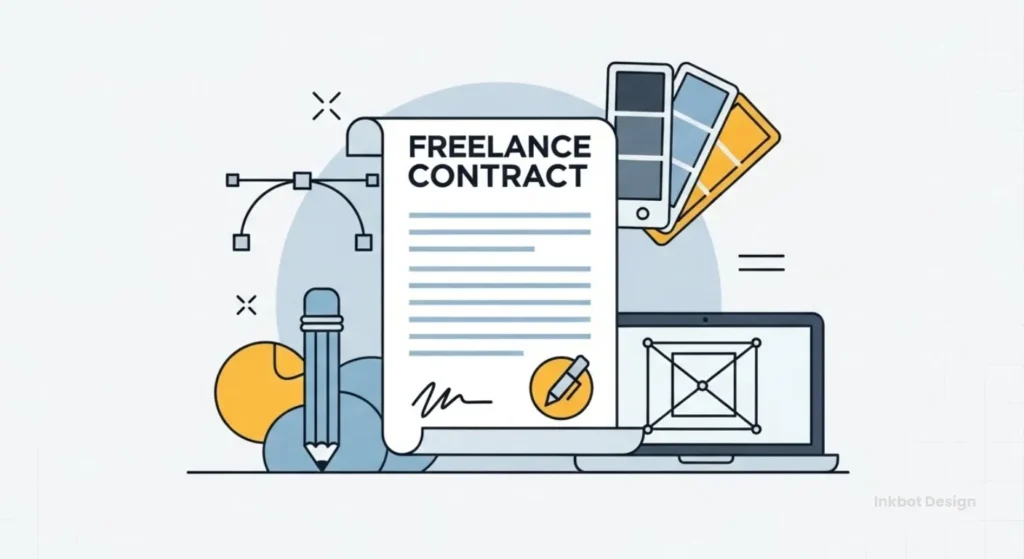
The 2026 Professional Contract Essentials
Your freelance agreement must now include three specific clauses:
- Origin Transparency: A detailed log of which AI models were used and the percentage of human-led refinement performed.
- Non-Infringement Warranty: A guarantee that the AI model’s “Latent Space” does not contain unauthorised copyrighted training data (which is why using Adobe Firefly 4, which is trained on licensed stock, is a major selling point).
- Copyright Ownership: Explicitly stating that the final “Human-in-the-Loop” polish constitutes enough original creative work to warrant copyright protection under current UK Intellectual Property Office standards.
Why Can’t I Just Use Free AI Tools?
Free or open-source models often lack the “Legal Safety Net” that corporate clients require. If a client is sued because your “free” AI tool scraped a competitor’s private data, you—the freelancer—will likely be held liable under “Professional Negligence.” Part of your high-tier fee is the cost of using Premium, Indemnified AI Suites that protect both you and your client.
The Verdict
The 2026 freelance economy is a brutal environment for those clinging to 20th-century definitions of “design.” My theory remains: if you are still selling manual execution, you are a data entry clerk.
The real money—the £200,000+ annual earnings—is reserved for the AI Design Orchestrators who can bridge the gap between business strategy and machine output.
We have seen that “software mastery” is a dying moat, while strategic prompt engineering and tool training are the new pillars of high-value creative work.
To succeed, you must stop being a pair of hands and start being a head. Avoid the platform tax by building your own authority and pivoting your skill set toward the growth areas of prompt engineering and AI integration.
This is the only way to ensure your freelance survival in a world where the “how” is free, but the “why” is more expensive than ever.
If you are a business owner looking to navigate this shift without making an expensive mistake, explore Inkbot Design’s services and read our related posts to see how we integrate human strategy with cutting-edge AI.
FAQs
What is the average freelance designer salary in 2026?
The average freelance designer in the U.S. earns approximately £76,300 ($99,230) per year, but this figure is heavily skewed. Strategic AI consultants frequently exceed £153,800 ($200,000), while designers focused on basic manual execution often earn closer to £38,800 ($50,500) due to increased automation.
Is prompt engineering a legitimate design skill in 2026?
Prompt engineering is a core technical skill for modern designers, involving the creation of complex instructions to ensure AI tools produce brand-consistent results. It allows designers to move from manual pixel manipulation to high-level visual orchestration, significantly increasing their output efficiency and strategic value.
Why are freelance platform fees considered a “tax”?
Platform fees on sites like Upwork and Fiverr function as a tax because they can reduce a freelancer’s gross income by £4,600 to £9,200 annually. These commissions, processing fees, and bidding costs must be paid before any other business expenses or taxes are calculated, impacting net margins.
How has AI affected the demand for graphic designers?
Demand for “simple graphic design” has fallen by 17% as AI tools allow non-designers to handle basic tasks. However, demand for specialists who can train AI models or edit AI-generated content has grown by over 165%, shifting the market toward more strategic, high-value roles.
What is the difference between an amateur and a pro AI designer?
Amateur AI designers rely on generic, one-off prompts, resulting in unoriginal, “AI-looking” work. Professional designers build custom-trained models (like LoRAs), perform high-fidelity human retouching, and integrate AI into a broader brand strategy that machine algorithms cannot replicate on their own.
Can I still make a living without using AI in 2026?
Making a living without AI is possible, but increasingly difficult, as you will be competing with the speed and cost efficiency of AI-enabled designers. Without AI, your pricing must reflect a significant manual labour premium, which is only sustainable in hyper-niche, high-end luxury markets.
What are the fastest-growing freelance skills right now?
Prompt Engineering (+240% growth), AI Content Editing (+180%), and AI Tool Training (+165%) are the fastest-growing skills in the 2026 freelance economy. These roles focus on managing and refining generative systems rather than producing basic creative assets from scratch.
Why is “software mastery” no longer a primary design skill?
Software mastery is no longer a moat because AI-native tools have automated the technical execution of Photoshop and Illustrator tasks. The value has shifted from knowing “how” to click a mouse to knowing “why” a specific visual direction aligns with a client’s business goals.
How do I avoid the 10%–20% platform commission on Upwork?
Avoiding platform commissions requires building an independent authority through direct networking, technical SEO, and content marketing. By attracting clients directly to your own website, you retain 100% of your earnings and maintain control over your client relationships and brand.
What is the “earnings gap” in the freelance economy?
The earnings gap refers to the widening disparity between the top 10% of freelancers who earn over £153,800 and the bottom 25% who earn around £38,800. This gap is driven by the automation of low-value tasks, leaving high-value strategy as the only remaining premium services.