The Design Guide to Business Card Sizes & Dimensions
A business card is a simple tool. It’s a physical token of introduction, a prompt for a future conversation. Yet, an incredible amount of time is wasted debating its dimensions, often driven by a misguided desire to “be different.”
The size of your business card isn’t an artistic statement. It’s a functional choice.
And in most cases, the best option is the one that has been tested and refined for decades: the standard.
This guide will give you the exact dimensions you need and, more importantly, explain why they work.
- Standard business card sizes are functional, widely accepted, and reduce waste and costs for printing.
- The best dimensions depend on the region: USA/Canada, UK/Europe, Japan, and Oceania have specific standards.
- Incorporate bleed and safe zones in design to ensure no important information gets cut off.
- Custom sizes can detract from practicality; the standard size enhances professionalism and usability.
A Table of Standard Business Card Sizes
You came for the numbers, so here they are. These are the established standards in major economic regions. Pick the one for your primary market.
| Region | Dimensions (Inches) | Dimensions (Millimetres) | Notes |
| USA / Canada | 3.5″ x 2″ | 88.9 x 50.8 mm | The most common standard in North America. |
| UK / Most of Europe | 3.346″ x 2.165″ | 85 x 55 mm | Very close to the size of a standard credit card, making it a perfect wallet fit. |
| Japan (Meishi) | 3.582″ x 2.165″ | 91 x 55 mm | Slightly wider than the European standard. Exchanging ‘Meishi’ has a deep cultural significance. |
| Oceania / Australia | 3.54″ x 2.165″ | 90 x 55 mm | A common size in Australia, New Zealand, and surrounding countries. |
There. That’s the core of it. For 95% of businesses, choosing the standard for your region is the correct, final, and most intelligent decision. Now, let’s discuss the technical details that actually matter.
The Anatomy of a Business Card File: Beyond Just Size
If you’re preparing a file for print, the final dimensions are only one part of the story. Your printer is working with three critical zones. Getting this wrong is one of my biggest pet peeves; it’s why “print-ready” files get rejected.

Trim Line: The Actual Edge of Your Card
This is the finished size of your card. It’s the line where the industrial guillotine will chop through the paper. When you order a 3.5″ x 2″ card, the trim line defines that final dimension.
Bleed Area: Your Design’s Essential Safety Net
This is the most misunderstood concept for non-designers. The bleed is an extra border—typically 3mm (or 0.125 inches)—added to all four sides of your design.
Imagine you have a card with a solid blue background. You must extend that blue colour into the bleed area. Why? Because paper shifts slightly during printing and cutting. Without bleed, any tiny misalignment would leave an ugly sliver of white paper along the edge of your finished card.
Bleed ensures that your background colour or image “bleeds” off the edge for a clean, professional finish. It gets trimmed off, but it’s your insurance policy against a sloppy result.
Safe Zone (or Margin): Keep Your Vitals Inbounds
Just as the bleed area sits outside the trim line, the safe zone sits inside it. This is an internal margin, also typically 3mm (or 0.125 inches) from the trim line, where all your critical information—your name, logo, phone number—must live.
Like the bleed protects you from white edges, the safe zone protects your text from being accidentally clipped during trimming. Anything outside this zone is at risk of being cut off.
Why Do Standard Sizes Even Exist? (Hint: It’s Not a Conspiracy)
Standardisation isn’t about stifling creativity. It’s about codifying what works in the real world. A standard business card size dominates for three brutally practical reasons.

The Wallet Factor: The Ultimate Test of Practicality
Where does a business card go after you hand it over? If you’re lucky, it goes into a wallet or a cardholder. Both of these have standard dimensions. The UK/EU size of 85 x 55 mm is particularly effective because it’s almost identical to a credit card.
This is where the obsession with square cards falls apart. They look interesting on a design blog, but they’re an immediate inconvenience in a person’s hand. They don’t fit. They require a separate pocket or get dumped in a bag, drastically reducing their lifespan. Your card’s first job is to be easy to keep. A non-standard size is an immediate fail.
The Cost Factor: Standardisation Equals Savings
Professional printers don’t print one business card at a time. They arrange dozens of cards (a process called imposition) onto massive sheets of paper. Standard sizes are designed to fit onto these sheets with mathematical precision, minimising wasted paper.
When you request a custom size, you’re breaking that efficiency. It often requires a custom setup, creates more waste, and that extra cost is passed directly on to you. Sticking to the standard is cheaper and faster.
The Professionalism Factor: A Universal Handshake
In many cultures, the exchange of business cards is a formal ritual. The Japanese “Meishi” exchange is a perfect example, with a clear etiquette dictating how the card is presented and received.
While less formal in the West, the principle remains. A standard-sized card feels substantial and professional. It aligns with expectations. Handing someone an oddly shaped or tiny card can sometimes feel less like a serious business introduction and more like a novelty.
The Allure of the Unconventional: When to Break the Rules
Sometimes, breaking the rules can work. But it must be a calculated risk, deeply rooted in your brand strategy, not a whim.
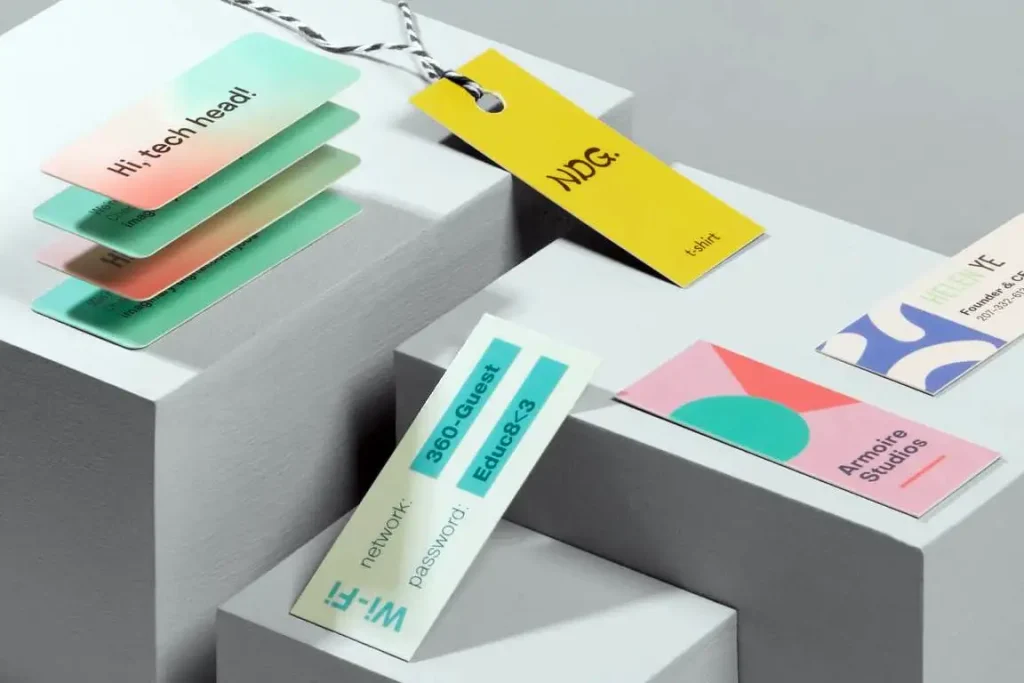
Square Business Cards
- Pros: They have a modern, minimalist appeal, especially for visually-led brands like photographers or designers. They stand out on a table.
- Cons: As mentioned, they are a nightmare for storage. The recipient must try to keep your card, and most won’t. You’re sacrificing function for a fleeting moment of form.
Mini or “Slim” Business Cards
- Pros: Popularised by printers like MOO, these smaller cards are unique and can feel sleek. They can force you to be concise with your information.
- Cons: They are incredibly easy to lose. Their small size makes them feel flimsy or insubstantial, and there is little room for information beyond the absolute basics.
Folded Business Cards
- Pros: The clear winner if you need more space. A folded card (essentially two standard cards joined together) provides four panels. This is perfect for appointment cards, mini-menus, or showcasing a small product gallery.
- Cons: They are bulkier and don’t slide as easily into a wallet. They cost more to print and require a more considered design to work effectively.
Custom Die-Cut Shapes
- Pros: If your business is a guitar shop and your card is shaped like a guitar pick, it’s undeniably memorable. A die-cut can create a powerful brand link.
- Cons: This is the most expensive and riskiest option. The cost is significantly higher due to the creation of a custom cutting die. Worse, it guarantees your card will be treated as a gimmick. The carpenter with a saw-shaped card gets a nod for cleverness, but that card will never see the inside of a Rolodex.
The Designer’s Checklist: What Your Printer Needs From You
Before you send your file off, run through this list. Providing a perfect file makes the process cheaper, faster, and ensures the desired result.
- Dimensions & Bleed: Is the canvas size set to the final trim size plus the 3mm (0.125″) bleed on all four sides?
- Resolution: Is the entire file, including all images, set to 300 DPI (Dots Per Inch)? Anything lower will look blurry in print.
- Colour Mode: Is the file in CMYK (Cyan, Magenta, Yellow, Key/Black)? Files designed in RGB (for screens) will notice a colour shift when printed.
- Fonts: Are all fonts outlined (converted to shapes) or embedded in the file? This prevents font substitution issues at the printer.
- File Format: Have you exported it as a high-quality, press-ready PDF? This is the universal standard.
So, What Business Card Size Should You Actually Choose?
Let me be direct.
For 95% of businesses—from consultants and contractors to cafes and tech startups—stick to the standard size for your region. It is the most practical, cost-effective, and professional choice. Full stop.
Devote your energy to creating a robust design within those standard constraints. A brilliant logo, sharp typography, a clear message, and high-quality card stock will make a far greater impression than an inconvenient shape.
Only consider a custom size if the shape is so integral to your brand identity that it justifies the extra cost and the practical drawbacks. And even then, think long and hard about what you’re asking the recipient to do with it.
Your business card is a tool for connection, not a piece of abstract art. Make sure it’s designed to do its job.
Need a Business Card That Actually Works?
Choosing the right size is the first step. The next step is to create a design that grabs attention and communicates your value. If you’re tired of generic templates and want a professional design that gets results, our business card design service is built for businesses like yours. We handle the technical specs so you can focus on making a great first impression.
Frequently Asked Questions About Business Card Sizes
What is the standard business card size in the UK?
The standard size in the UK and most of Europe is 85 x 55 mm. This is very similar to the dimensions of a credit card.
What are the dimensions of a US business card?
The standard US and Canadian business card size is 3.5 x 2 inches (88.9 x 50.8 mm).
Do I really need bleed on my business card design?
Yes, absolutely. If any colour, image, or design element touches the edge of your card, you need a bleed of at least 3mm (0.125″). It prevents ugly white borders from appearing after the cards are trimmed.
What is the difference between CMYK and RGB?
CMYK (Cyan, Magenta, Yellow, Key/Black) is the colour model for four-colour printing. RGB (Red, Green, Blue) is the colour model for digital screens (computers, phones). All print files must be in CMYK for accurate colour reproduction.
What does 300 DPI mean for a business card?
DPI stands for Dots Per Inch. 300 DPI is the standard resolution for high-quality printing, ensuring that your text and images are sharp and clear, not pixelated or blurry.
Are square business cards a bad idea?
From a practical standpoint, they are often a poor choice. While visually distinct, they do not fit in standard wallets or cardholders, making them inconvenient for recipients to keep.
What is the best file format for a business card?
A high-resolution, press-ready PDF is the universal standard. It should have all fonts outlined or embedded and include the proper bleed.
What are “Meishi” cards?
“Meishi” is the Japanese word for business card. The standard size is 91 x 55 mm, and their exchange is integral to Japanese business etiquette.
Can I make a business card in Microsoft Word or Canva?
While you can, setting up professional print specifications like bleed and CMYK colour mode can be tricky. Professional design software like Adobe Illustrator or InDesign is recommended. If using Canva, select their “Print” templates and export with bleed and crop marks.
Is a thicker business card better?
Often, yes. The weight and feel of the cardstock (paper) contribute significantly to the perception of quality. A thicker, heavier card feels more premium and substantial than a flimsy one, regardless of its dimensions.
What is the smallest readable font size for a business card?
Generally, you should not go smaller than 7 or 8 points for contact information. Your name and company name can be larger. Readability is crucial.
Should I put my photo on my business card?
This depends on your industry. For real estate agents, consultants, and speakers, a professional headshot can help people remember who you are. For a design agency or a law firm, it’s less common.
The dimensions are just the container. The design inside is what makes the connection. Let’s talk if you’re ready for a business card that looks and feels as professional as your business. Explore our business card design services or request a quote to get started.