The Unboxing Experience: Turning Logistics into Loyalty
I have a question for you. When your customer receives your product, do they feel like they have just received a gift, or do they feel like they have just been handed a chore?
Most entrepreneurs obsess over their website’s UX. They agonise over the kerning on their landing page. They burn cash on PPC ads to get a customer through the door.
But the moment the transaction clears, the “brand experience” often falls off a cliff.
The product is placed into a generic corrugated box, sealed with standard packing tape, and handed over to a courier who treats it like a rugby ball.
This is a fundamental failure of branding.
The unboxing experience is the final mile of your brand narrative. It is the moment where digital promises meet physical reality. It is the only marketing channel you have that boasts a 100% open rate. Every single customer will see, touch, and interact with it.
Yet, so many businesses treat it as a logistical afterthought—a cost centre to be minimised rather than a value driver to be optimised.
If you think unboxing is just about pretty tissue paper and a sticker, you are leaving money on the table.
Let’s strip away the fluff and look at the mechanics of why packaging matters, how it influences retention, and how to execute it without bankrupting your logistics department.
- Unboxing is the final brand touchpoint — a 100% open-rate marketing moment that validates the purchase and builds loyalty.
- Design around three pillars: structural protection, sensory orchestration, and tight brand alignment with digital identity.
- Optimise for warehouse speed: packaging assembly should take under 30 seconds to avoid killing margins at scale.
- Make packaging sustainable and recyclable — consumers punish greenwashing; aim for mono-materials and visible eco choices.
- Measure ROI by CLV, return rates, and UGC; packaging cost should be 1–3% of retail price for optimal impact.
What is the Unboxing Experience?
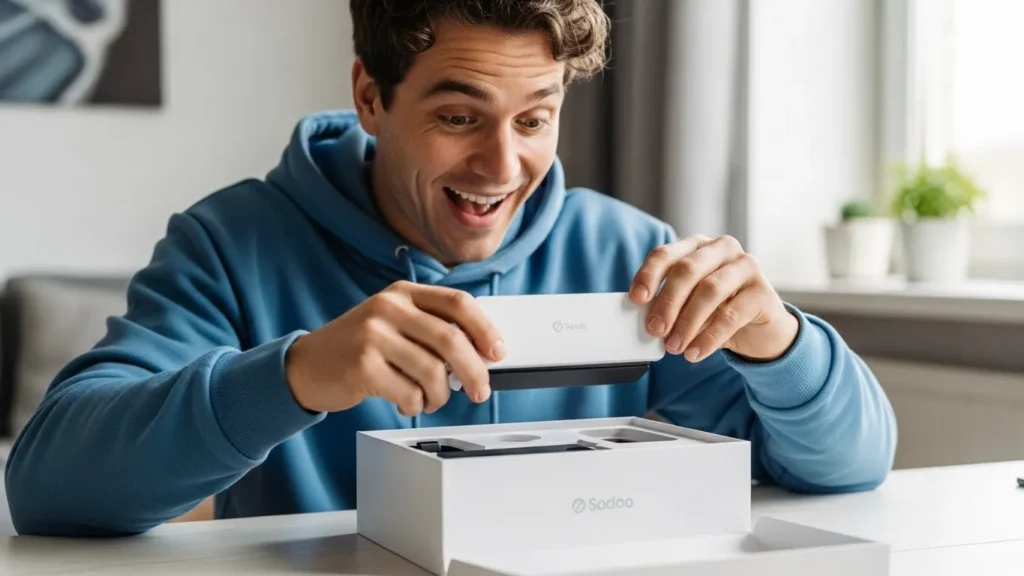
Technically, the unboxing experience is the series of emotions and sensory interactions a customer goes through from the moment they see your package on their doorstep to the moment they hold your product in their hands.
Strategically, it is a post-purchase retention mechanism designed to validate the buying decision and reduce buyer’s remorse.
The Core Components
A viable unboxing strategy relies on three pillars:
- Structural Integrity: The vessel must protect the asset. If the product arrives broken, the “experience” is a refund request.
- Sensory Orchestration: The tactile feel of materials, the sound of the seal breaking, and the visual reveal sequence.
- Brand Alignment: The physical packaging must match the digital identity. A luxury watch cannot arrive in a bubble mailer.
The Psychology of the Box: Why We Care
Why do millions of people watch strangers open boxes on YouTube? The channel Unbox Therapy has over 24 million subscribers. This is not a niche fetish; it is mainstream consumer behaviour.
The psychology behind this phenomenon is rooted in anticipation and the release of dopamine.
The Dopamine Loop
When a customer sees a package, their brain releases dopamine—the neurotransmitter associated with pleasure and reward. This is the same chemical hit you get from a “Like” on Instagram or winning a small bet. A well-designed unboxing experience can prolong the release.
If the package is hard to open, ugly, or frustrating, that dopamine turns into cortisol (stress). This is the “wrap rage” phenomenon. You have taken a moment of joy and turned it into a moment of annoyance.
Post-Purchase Rationalisation
Every buyer experiences a degree of “Buyer’s Remorse” or cognitive dissonance immediately after making a purchase. Did I spend too much? Do I really need this?
Premium packaging acts as an immediate sedative for this anxiety. It signals value. When an iPhone box slides open with that perfectly engineered resistance (taking exactly 7 seconds), it subconsciously tells the user: “This device is precise. This device is worth the money.”
A study by Dotcom Distribution found that 40% of online shoppers would be more likely to make a repeat purchase from a retailer if they had ordered a premium package. That is a massive retention lever hidden in cardboard.
The Strategic Elements of Unboxing
You do not need an Apple-sized budget to create a competent unboxing experience. You just need to be intentional. We break this down into the “Layers of Reveal.”
1. The Exterior Shipping Container
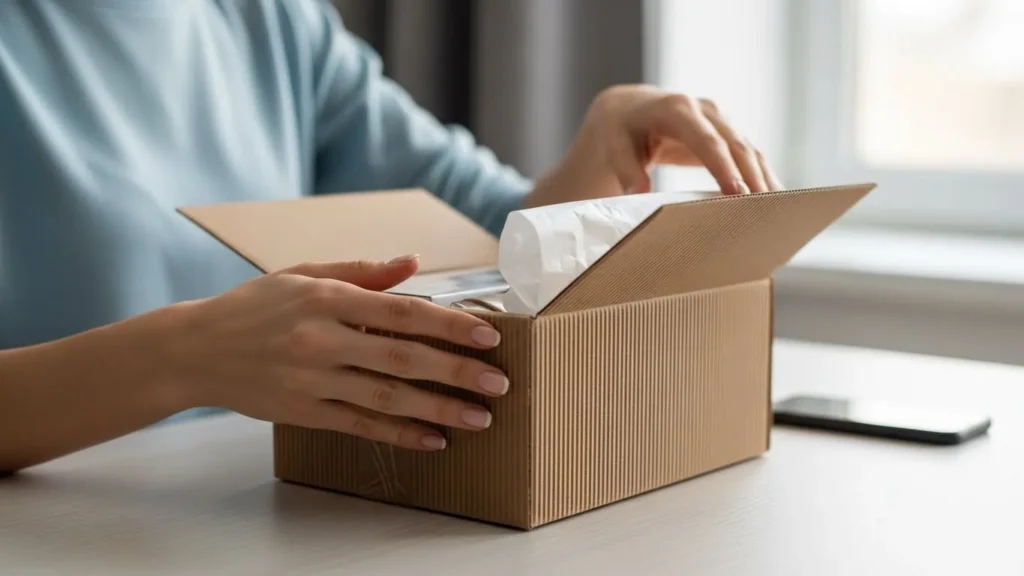
This is the first impression. Most brands use a plain brown corrugated box (Kraft). This is fine for commodity goods, but it is a wasted billboard.
- The Custom Mailer: Printing your logo on the outside is the baseline. It builds anticipation before the customer even touches the box.
- The “Stealth” Approach: High-value items (jewellery, electronics) often feature plain exteriors for theft prevention, reserving branding for the interior of the box. This is a valid security vs. branding trade-off.
- Tape: Do not use standard clear packing tape. Custom gummed tape (water-activated) is stronger, tamper-evident, and provides an additional branding surface.
2. Internal Presentation & Protection
This is where the magic (or the mess) happens.
Void Fill:
- The Amateur Move: Polystyrene peanuts. They are messy, static-charged, and hated by customers. They scream, “I don’t care about the environment or your vacuum cleaner.”
- The Pro Move: Crinkle paper, custom inserts, or moulded pulp. Custom inserts are the gold standard. They hold the product in place, presenting it face-up and centre-stage, rather than letting it rattle around like a maraca.
Tissue & Wraps:
Tissue paper adds a layer of ritual. It requires the user to physically “unwrap” the item, slowing down the process and increasing perceived value. Securing this with a branded sticker is a low-cost, high-impact touchpoint.
3. The “Gift” Component
This is the “Value-Add” that triggers reciprocity.
- Samples: A relevant sample (e.g., a moisturiser sample with a face wash purchase) is not just a gift; it is a disguised cross-sell attempt.
- The Personal Note: In the early days, handwritten notes were unbeatable. As you scale, a printed card with a handwritten signature or a high-quality “Welcome to the Club” card works.
- Educational Inserts: Don’t just send a receipt. Send a “How to Care for Your Product” guide. This reduces the number of support tickets and increases product longevity.
Haptics and Sensory Branding: The Invisible Interface
Visuals are easy. But sensory branding is where you win.
Haptics (Touch):
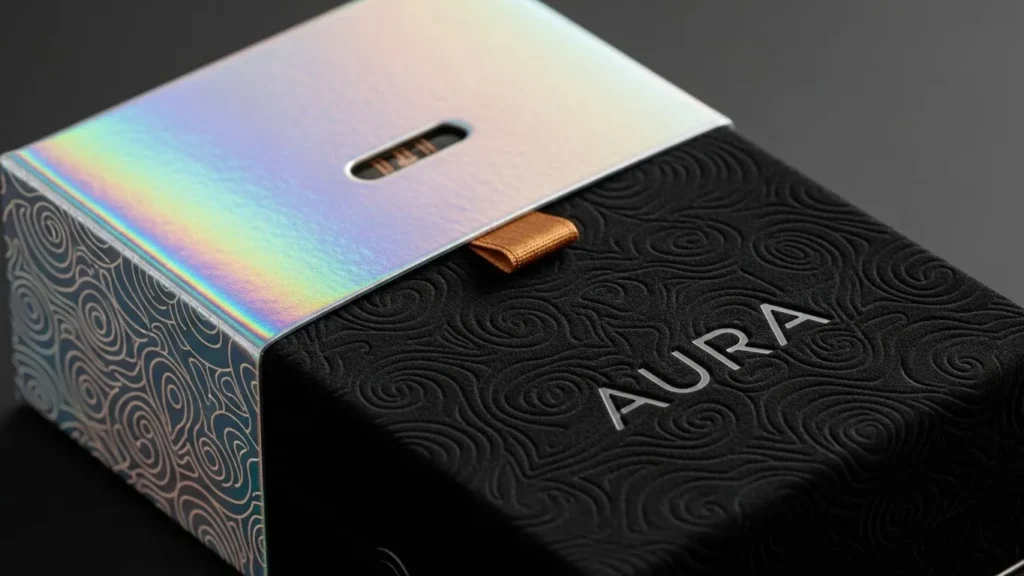
Consider the texture of your box. Is it rough, Kraft? Smooth matte laminate? Soft-touch velvet?
- Glossy finishes feel cheap and slippery.
- Matte and Soft-Touch finishes feel premium and sophisticated.
- Uncoated textured paper feels organic, sustainable, and honest.
Sound:
The sound of unboxing is overlooked.
- The “Whoosh”: The vacuum resistance of a rigid box (like Apple’s) creates a subconscious feeling of airtight quality.
- The “Crackle”: High-quality tissue paper makes a crisp sound. Cheap paper sounds soft and mushy.
- The “Snap”: Magnetic closures on rigid boxes provide a satisfying “clunk” that signals security.
I once consulted for a tech accessory brand. Their product was excellent, but the box was a nightmare. It was a blister pack that required scissors to open. We switched them to a simple tab-lock cardboard box. Returns dropped by 4% because customers weren’t starting their ownership experience with a negative attitude.
The Logistics Reality Check: Scaling the Experience
It is easy to design a beautiful box in Photoshop. It is much harder to pack 5,000 of them a day in a warehouse.
The Fulfilment Bottleneck
Complex packaging kills warehouse efficiency. If your packer has to tie a perfect bow, fold three layers of tissue, and apply a wax seal, your “Pick and Pack” time skyrockets.
The Rule of 30 Seconds:
Your unboxing experience should take no longer than 30 seconds for a warehouse worker to assemble. If it takes longer, your labour costs will eat away at your margins.
Dimensional Weight (DIM Weight):
Carriers like FedEx and UPS charge based on the size of the box, not just the weight. If you use a giant box for a small item just to fit in a lot of “fluff,” you are paying to ship air. Optimising box size is an economic necessity.
Inventory Management
Custom packaging means carrying a greater number of SKUs in stock. You need to store the boxes, inserts, tissue, and stickers. If you run out of custom boxes, can you ship in a plain one? Or does your entire operation halt? You need a contingency plan.
| Feature | The Amateur Approach | The Professional Approach |
| Box Type | Standard U-Line Brown Box | Custom Die-Cut Mailer or Litho-Laminated Box |
| Protection | Bubble Wrap or Peanuts | Custom Corrugated Inserts or Moulded Pulp |
| Branding | Inkjet Receipt thrown on top | Branded Packing Slip in a sleeve/envelope |
| Closure | Clear Plastic Tape | Water-Activated Custom Gummed Tape |
| Unboxing Time | 2 seconds (Rip and tear) | 15-30 seconds (Reveal sequence) |
| Sustainability | Mixed materials (Plastic + Cardboard) | Mono-material (100% Curbside Recyclable) |
Sustainability: The Greenwashing Trap
In 2026, sustainability is not a “nice to have.” It is a licence to operate.
Consumers are becoming hyper-aware of packaging waste. If you send a small USB drive in a shoebox filled with plastic air pillows, you will get roasted on social media. This is “packaging shaming,” and it is a real phenomenon.
The “Curbside Recyclable” Standard
Your goal should be 100% curbside recyclability.
- Avoid: plastic laminates on cardboard (which makes it unrecyclable), plastic blister packs, and mixed-material windows.
- Embrace: Soy-based inks, water-based glues, FSC-certified cardboard, compostable mailers.
McKinsey & Company reports that over 60% of consumers would be willing to pay a premium for sustainable packaging. However, they are also savvy enough to spot greenwashing. Don’t just slap an “Eco-Friendly” icon on a plastic bag. Use materials that are visibly, obviously organic.
Real-World Case Studies: Who Gets It Right?
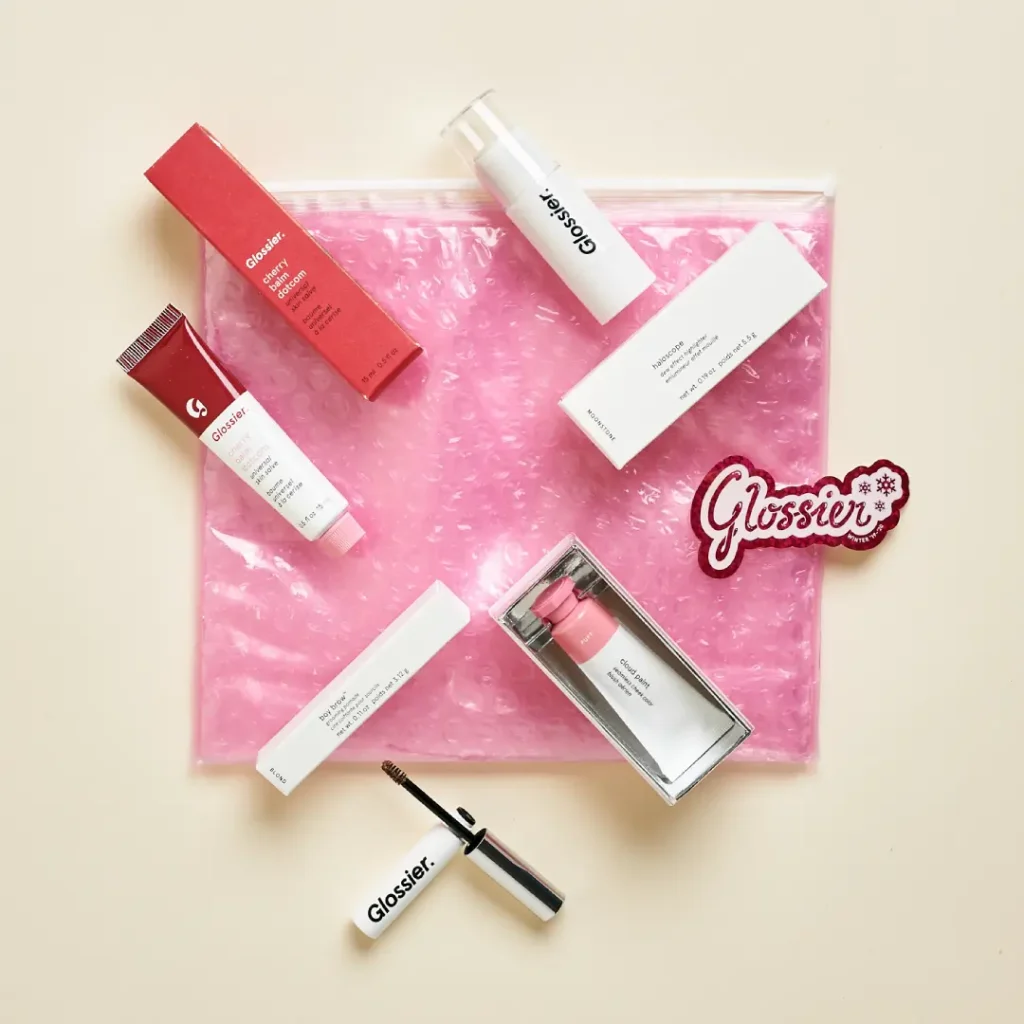
1. Glossier: The Pink Pouch
Glossier didn’t just sell makeup; they sold a club membership. Their orders arrived in a pink bubble-wrap pouch (similar to a ziplock bag).
- The Genius: The pouch wasn’t trash. It was durable. Customers reused them as pencil cases, travel bags, and clutches. It became a status symbol.
- The Result: Millions of dollars in free User Generated Content (UGC) as people posted their pink pouches on Instagram. The packaging was the marketing.
2. Apple: The Gold Standard
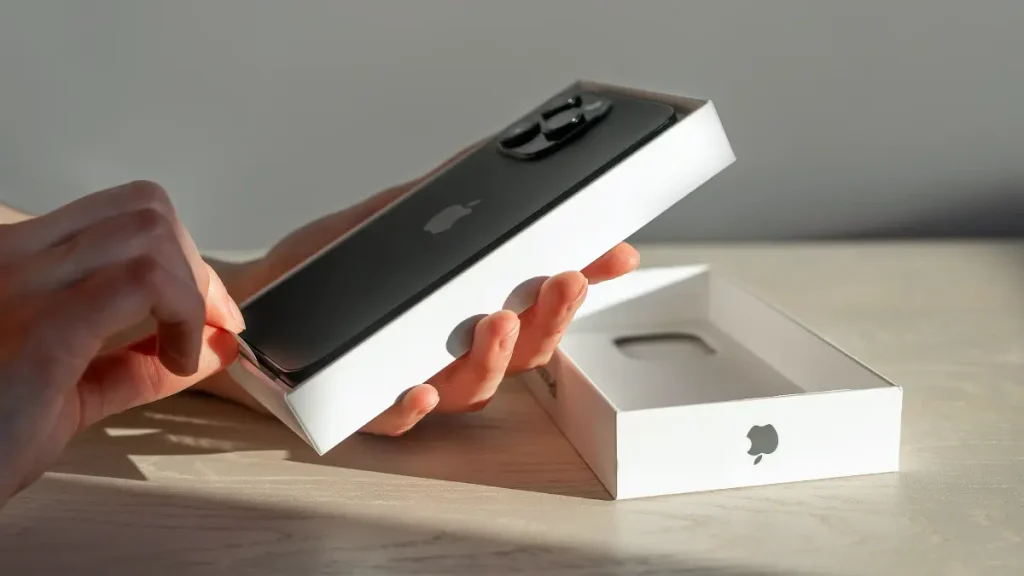
Apple spends millions on packaging engineering.
- The Genius: The “friction hinge.” When you lift the lid of an iPhone box, the bottom part slides out slowly. It doesn’t drop. It glides. This forces you to slow down. It builds reverence for the object inside.
- The Lesson: Pacing matters. Control the speed at which your customer accesses the product.
3. Man Crates: Gamifying the Struggle
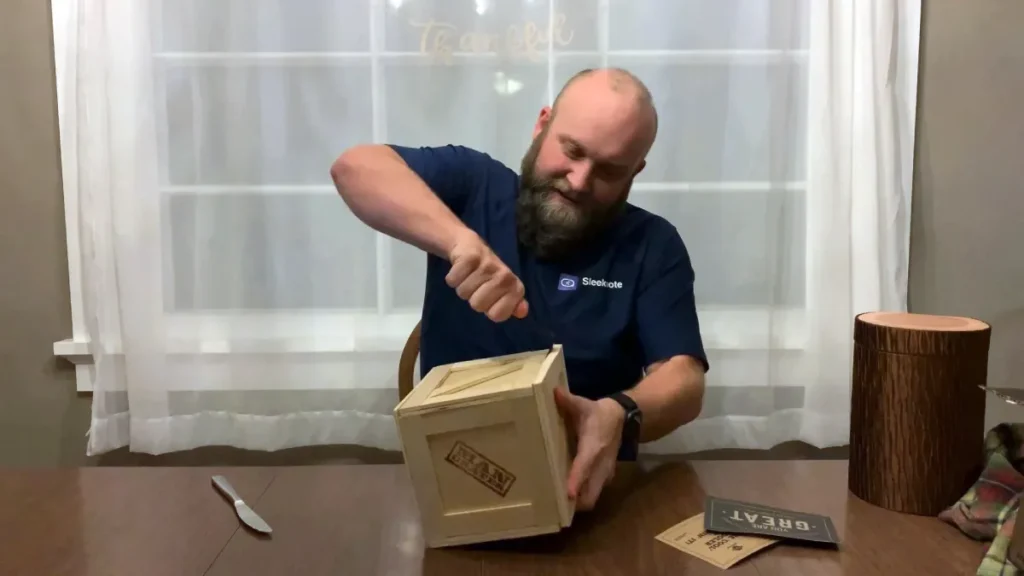
Man Crates ships gifts for men in wooden crates that have to be pried open with a crowbar (included).
- The Genius: They turned the “annoyance” of opening a package into a challenge. It aligns perfectly with their rugged brand identity.
- The Lesson: Know your audience. This would fail for a luxury handbag, but for tools like jerky and whiskey, it is perfect.
The ROI of Unboxing: Show Me The Money
You might be thinking, “This sounds expensive. What is the return?”
We measure the ROI of brand experience through three metrics:
- Customer Lifetime Value (CLV):
Premium packaging increases perceived value. Customers who perceive high value are less price-sensitive and more likely to repurchase. - Return Rates:
As mentioned, accurate and secure packaging reduces damage. But the psychological effect also lowers returns. It is harder to return an item that felt like a gift than one that arrived in poor condition. - User Generated Content (UGC) / Earned Media:
If 1,000 customers post your unboxing on Instagram Stories, and each has 500 followers, that equals 500,000 impressions. What would that cost you in Facebook Ads? The cost of the box is often lower than the CPM (Cost Per Mille) of the advertising value it generates.
The “Cost Per Box” Formula
Do not look at the absolute cost. Look at the percentage of AOV (Average Order Value).
If you sell a £20 item, spending £3 on a box is a bad move (15% of revenue).
If you sell a £200 item, spending £3 on a box is negligible (1.5% of revenue) for a massive brand lift.
A general rule of thumb for e-commerce is that Packaging costs should be 1% to 3% of the product’s retail price.
The State of Unboxing in 2026: Connected Packaging
We are moving past static cardboard. The future is Connected Packaging.
This involves integrating QR codes, NFC (Near Field Communication) tags, or AR (Augmented Reality) markers directly into the packaging design.
- Authentication: Scan the box to verify the product is genuine (huge for sneakers and luxury goods).
- Reordering: Tap your phone to the empty box to instantly add a refill to your cart.
- Storytelling: Point your camera at the wine label to see a video of the vineyard.
This bridges the gap between the physical unboxing and the digital customer journey mapping. It turns a dead piece of cardboard into a live data point.
A Reality Check
I frequently see this mistake: A client spends £15,000 on a brand identity project. We design a stunning logo, colour palette, and typography system.
Then, they launch. I ordered a product to test the flow. It arrives in a grey plastic poly mailer that smells of chemicals. The invoice is a crumpled piece of A4 paper. The product is wrapped in excessive bubble wrap taped with cheap scotch tape.
The brand equity evaporates instantly.
Your brand is not what you say it is on your About page. Your brand is what the customer holds in their hand. If there is a disconnect between your digital promise and your physical delivery, you are eroding trust.
Consistency is boring, but consistency is profitable.
The Verdict
The unboxing experience is not about bows and ribbons. It is a calculated operational strategy that impacts your bottom line. It distinguishes a brand from a dropshipper.
In a crowded market, your product is likely similar to those of your competitors. Your website likely resembles this one. Physical interaction is one of the few remaining areas where a “moat”—a defensible competitive advantage —can be created.
Do not build a brand that looks like a Ferrari online and arrives like a Fiat Panda.
If you are ready to align your physical touchpoints with your brand strategy, we should talk.
Frequently Asked Questions (FAQ)
What is the ideal budget for unboxing packaging?
Aim for 1-3% of your product’s retail price. For luxury goods, this can stretch to 5%. For low-margin commodity goods, focus on a branded sticker or tape (under £0.50 per unit) rather than full custom boxes.
Does custom packaging actually increase sales?
Directly? Sometimes. Indirectly? Absolutely. Data from Dotcom Distribution suggests 40% of consumers are more likely to repurchase from a brand with premium packaging. It drives retention, which is the engine of sales growth.
How do I make my packaging sustainable?
Switch to mono-materials (all paper/cardboard). Remove magnets and plastic windows. Use soy or algae-based inks. Ensure the box size is optimised for the product to reduce the carbon footprint during shipping.
What is the difference between a mailer box and a shipping box?
A shipping box (RSC – Regular Slotted Container) is a standard box taped at the top and bottom. A mailer box is usually die-cut, self-locking, and opens like a pizza box or treasure chest. Mailer boxes offer a superior presentation.
Can I brand a standard brown box?
Yes. You can use custom rubber stamps (for a rustic look), custom packing tape, or high-quality branded stickers. This is a cost-effective way to brand stock packaging without high minimum order quantities.
What is “void fill” and why does it matter?
Void fill is the material used to fill the empty space in a box (tissue, crinkled paper, air pillows). It matters because it protects the product and affects the unboxing aesthetics. Avoid styrofoam peanuts at all costs.
How does packaging affect shipping costs?
Carriers use “Dimensional Weight” (DIM Weight). If your box is large but light, you are charged for the size. Optimising your packaging to be as small as possible while still protecting the product will save significant shipping costs.
What is “Connected Packaging”?
This refers to packaging that incorporates digital triggers, such as QR codes, NFC tags, or AR markers. It allows customers to access digital content, tutorials, or reorder pages by scanning the physical box.
Should I put the invoice inside the box?
Yes, but don’t just throw it in. Place it in a branded envelope or fold it neatly. Consider omitting pricing if it is a gift order (offer a gift receipt option at checkout).
How do I stop “Porch Pirates” while branding my box?
Use a plain exterior shipping box (or poly mailer) to hide the contents, and place the high-end branded box inside that. This is known as “Russian Doll” packaging. It protects the brand experience and the asset.